Showing posts with label School. Show all posts

Friday, March 13, 2015

Spring Is Here (Almost); Hurray!

As we all know, Boston has received (almost) record amounts of snow this spring not-spring. We would like to smugly suggest that we were reasonably prepared for such an occasion.

The amount of snow obviously caused difficulties with things like going to school, life, getting places, eating, and being a human. While it was really hard to exist with all the white stuff falling from the sky all the time, there were a few things that were facilitated by the vast amount of cloud dust:

1) Swimming practice.

Can't get to the pool? No problem!

2) Friendly interactions with neighbors.

Day 1

Day 21
3) No need to go to the gym!


No need for you, gym! I get enough of a workout walking everywhere because my bus isn't running!
4) Hilarious jokes in the newspapers!
... This is a joke, right? ... Right?!
Luckily, the sun is shining, birds are singing, and trains are angrily blaring their horns at pedestrians across from the CFA. Here are some awesome things to check out whilst the weather is nicer than it has been (and let's face it, we are REALLY appreciative of basic things like being able to get to parking meters and not having to climb Mount Snow-manjaro to get to an intersection):


1) Visit the Boston Common.
This historic park is probably pretty familiar to all of you, but did you know that it's housed the British army, an execution after a witch trial, and a major Vietnam protest?


2) Take the T.
The MBTA is back up and running! Also, they have announced 15% fare discounts in May, and a FREE RIDE DAY in April!


3) Get bubble tea in Allston.
This bubble tea is, in our opinion, totally 100% worth walking to Harvard Ave. Drink it in the sun!


4) Go to Cold Stone.
10 out of 10 Andy Chaes in the School of Music office prefer Cold Stone.


What are you doing this spring? How are you replenishing your requisite Vitamin D deposits?

Monday, October 27, 2014

STRESS SERIES!: Experiment Number One: Throwing a Party

This week, to combat the slow, sneaky stress of the mid-semester stretch, we decided to throw a Halloween party. Why? Because Halloween is so awesome. Who is we? The Royal We. What is going on again?! A party.

Normally at the end of the week, we are basically non-functional.

Figure 1: Non-function.

The idea of throwing a party was daunting at best, and at worst caused our brains to explode. However, we bravely soldiered on with digging the box of Halloween goodies out of the basement and Googling "snarky costumes lol."

Half-way through decorating, we were hit with the tired stick (otherwise known as the "WHAT AM I DOING I HAVE TO STUDY!!!!!!11!!" stick") and ended up taking a twenty-minute coma nap under a cat.

Figure 2: Cat Nap is Incomplete Without Cat
This actually was an excellent idea and left us feeling very relaxed. Cat also seemed to enjoy it.

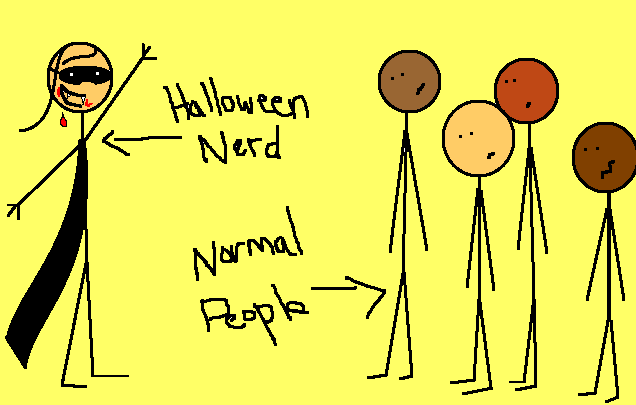
One stressful and perennial fear is that we will take Halloween more seriously than others. This manifests itself by involved costumes containing a large volume of fake blood, capes, and other props. While it seems like an awesome idea, it is awkward to be the only one at a party who looks thus.

Well. This is awkward.
So we spent some time coming up with a costume made up of one piece of paper that we could take off if necessary (IE, if we were the only ones in costume). We then spent some time making gross food (gross both because of the way it looked and because of the amount of butter present).

It's a HAND-MADE CAKE!!! Get it??!

Finally, we decorated the heck out of the apartment. Spiderwebs everywhere.

I... don't know how to feel.

The party came and went with plentiful food, fun, and ease. Clean-up only took about twenty minutes, and we filled the dishwasher ONLY ONCE (the true definition of a successful party).

While we were worried about costumes and decor, and while making food for an undetermined amount of people was a little difficult, we found this event to actually be moderately de-stressing.

DE-STRESS SCORE: 6/10

Surprisingly, after we were done cleaning up and had had a good night's sleep, we were refreshed because the party broke up the monotony of the weekly homework routine. It was nice to prioritize hanging out with friends, eating nasty, buttery food, and putting spiderwebs on the cat.

I'm still here.
We would definitely recommend taking a break to spend time with friends during this crazy season. Lucky for you, Halloween isn't over! Grab a vat of fake blood and enjoy the most wonderful season of the year.

Thursday, October 23, 2014

And Now for a Non-Musical Interlude: STRESS! and How (and Why) You Should Care

So we are quickly hurtling toward the end of the semester and you feel stressed.

Big deal. Everyone is stressed. 
WHY IS EVERYTHING RED?!
Okay, maybe yes, everyone IS stressed. But stress is not good for our bodies or brains, both of which we need to play musical instruments. This article says the following scary things:

- 75%-90% of all visits to the doctor's office are for stress-related complaints.
- Stress costs American industry more than $300 billion annually. That is enough to pay off EVEN OUR student loans.
- 43% of all adults suffer adverse health affects from stress.

So it seems fairly clear that this is bad. But WHAT KINDS of bad things happen from stress?
Short-term stress.
Annoying, and kind of no big deal. BUT, over time, stress can have long-lasting and unpleasant effects.
Long-term stress, :-(
Yuck. Does not want.

A number of questions arise when we realize how bad stress is: how can we stop the inevitable? Can we avoid stress? How can we not panic when we have so much STUFF to do and practice for and write about?
Even THIS could be stressful (if you sunburn easily)

We'll be making a stab at some stress-busting case studies over the next months, where we will implement the following three steps:

1. Find a thing that is supposed to be a de-stressor.
2. Do that thing.
3. Think critically about its impact on our selves. Blog about it.

Stay tuned! And in the meantime, let us know if you do anything in particular to de-stress!

Friday, October 17, 2014

Handy Ways To Not Be Injured Safely On A Bike

We all know that city biking is a rewarding and wonderful way to get around, not to mention that in many cases it is also faster than other modes of public transportation (*cough* the green line *cough*). It is also, however, a dangerous undertaking. Here are some tips to stay safe on your bike this summer and throughout the school year.

1. BUY A HELMET. Riding without a helmet is so dangerous, you guys. Musicians need our heads (and faces, and brains) so protect them with a GOOD, HIGH-QUALITY helmet. Don't buy a used helmet; cracks can be invisible but significantly impact the quality of the helmet.

Where to buy a helmet? Here, here, or here. How to buy a helmet? By exchanging money for goods and services. Why should you spend money on a good helmet? Because of the brain thing previously mentioned. Will you look like a dork in your helmet? No.

The following picture illustrates how good you will look in your helmet:

2. Keep a constant eye on the right. If you bike in the bike lanes (WHICH YOU SHOULD) you will notice that cars, busses, and other sundry traffic pass through the bike lane. One particular hazard is opening car doors, as shown below:
3. Ride at the same speed as traffic. If you are riding faster than traffic, there is a chance that a car could miss you, cut over quickly, and cause an accident. As tempting as it is, don't speed past the poor, unfortunate cars stuck in traffic.

NO.

4. DO obey all traffic signs, lights, and signals. Bicycles are moving vehicles on the road and are therefore subject to all the same regulations and rules as cars. This also means that you can act all snooty when people tell you that you should bike on the sidewalk. Which you shouldn't.

Also, police have been pulling people over for riding unsafely. So, you don't even wanna mess with that.

5. Get a bike light! Ideally, these lights should be able to be solid or flashing, and white for the front of your bike with red on the back.
May your bike light reflect your own personal radiance.
The reason for the bike light is two-fold: first, you need to see at night. Sometimes streets are dark and you don't want to ride over (or into) something unpleasant. Second, cars need to see YOU. A light goes a long way toward preventing this:


Obviously this is just a basic guide for biking in Boston. For more information, or to get involved with bike activism in Boston, you can visit the Boston Cyclists Union, where you can sign a petition for protected bikeways on Commonwealth Ave., sign up to volunteer, and take a class on things like winterizing your bike.

Just remember, even though riding a bike is awesome, taking proper safety measures makes us EVEN COOLER. What do you do to stay safe on the roads?

Thursday, September 4, 2014

Getting Involved With The Community: BU ArtsOutreach!

Performance anxiety
and wobbly notes.
#woodwindproblems
We all know that music has the power to elevate us out of our current situations, change our mindsets, and lift our spirits. It can also move us profoundly and deeply. That's why we became musicians. Sharing the gift, however, is another story- if you're like we are, you sometimes feel that you perform only for people who are silently judging you, or who wish they could be at home watching Orange Is The New Black instead of listening to your Mozart concerto. You worked hard on that concerto. They could at least show a little enthusiasm for your historically accurate interpretation.

But sometimes playing out in the community can be the answer to these dreadful woes. Sometimes it's a relief to play for people who aren't also extremely high-level on your instrument, or who aren't musicians at all. Sometimes it's nice to get your feet on the ground and play for the audience music was meant for: human beings.


BU ArtsOutreach is a great program in which you can play music for patients in lobbies, foyers, pediatrics, geriatrics, surgical ward, adult outpatient, and trauma units at the BU Medical Campus. In other words, this program connects musicians with those who might need us the most: those under tremendous amounts of stress. 

YAY! EXTRA PERFORMANCE
OPPORTUNITIES!!
Do you wish you had more performing opportunities? Do you struggle with performance anxiety? Do you love to play Yanni music but your teacher won't let you put it on your recital? BU ArtsOutreach can help with these issues as well! Think of it as an extra opportunity to perform for people who are excited about hearing you play.

Who can play? Solo instruments or chamber groups. 
How do I get there? The B.U.S. will drive you to the Medical Campus FOR FREE. 
How do I sign up? Email Courtney Miller at BuArtsoutreach@gmail.com
Do I have to lug my music stand across town? No. You'll be provided with one there.

If you've already wondered how to get started performing in the community, and especially if Boston is new to you, this is an easy and wonderful way to get integrated into your new hometown. Not only will you be providing patients and staff at the BU Medical Campus with a sonic experience and good memories, but you'll also be giving yourself the gift of performing for people who need your music.


Saturday, August 2, 2014

And Now for a Non-Musical Interlude: The Remedy for the Common Cold That Won't Quit

The first year in a new place is always a treacherous time for airborne illnesses, even during the summer. A new environment brings new germs, among which lurks the common cold. A virus (and therefore not treatable by antibiotics unless there is a secondary infection) with over 200 strains, the common cold can knock wind- and brass-players off their feet for weeks, and can be especially devastating for vocalists. And obviously, while other instrumentalists may not play with their faces, feeling crummy is never positive for a practice routine.

The best cure for the common cold is rest and relaxation. The second-best is, we believe, this ridiculous concoction.
Your version of this will likely be pulpier.

You will need:
1 high-powered blender
1 strainer
1 mug
1 stove with pot, or microwave
______
1 cup apple juice (water will work in a pinch)
1 whole lemon
1 one-inch piece of fresh ginger, peeled
1 pinch of cayenne pepper
1 tablespoon of honey

Now, this is going to sound crazy. Cut the lemon in quarters and throw it in the blender without peeling or removing the seeds. Add the rest of the ingredients except for the honey, put the top on, and blend until it's nice and liquid-looking in there. In reality, there will probably be a lot of pulp.

Put your strainer over your mug or small stove-top pot, and slowly pour your mixture through. If your outcome is anything like mine, you will have to push the final bits of stuff with a spoon to get it to yield all of its healing goodness. Then, either warm the mixture on your stove, or microwave until it's steamy. Stir in the honey.
______

This mixture is full of Vitamin C, thanks to the lemon. And thanks to the cayenne pepper, it will sometimes leave unfortunate sinuses able to breathe for the first time in days. It takes a while to drink, but since this is the Chuck Norris of beverages, one would expect that it can't be quickly downed.

Do you have a never-fail remedy for the common cold?

Sunday, July 6, 2014

And Now for a Non-Musical Interlude: How To Stay Properly Warm in Winter

Who Took This Awesome Picture?
Please answer "yes" or "no" to the following questions:
1. Is there a need for shoes that are not flip-flops?
2. Do you get enough Vitamin D?
3. Would you, if you could, cozy up to a roaring fire mid-May?
4. Is it important to wear clothes lined with faux fur? 

Below are the correct answers for Boston:
1. Ten months out of the year, yes.
2. If by Vitamin D you mean Doritos, then yes.
3. There are times that, yes, I would. And I'm not ashamed.
4. I'm sorry, I couldn't hear you through my fuzzy hat.

If your answers are different, you might need to know How To Stay Properly Warm in Winter.

 1. Buy a proper coat. We aren't talking waterproof-but-uninsulated. We aren't even talking waist-length. Anything that could, in any context, be described as a "jacket" will not cut it. We need high-tech, insulation-filled, waterproof, knee-length, hooded coat. To save money, you can buy a real winter coat either a) in a warm climate (they are cheap where nobody needs them!) or b) in the off-season (summer sales!). As painful as it is to try on coats in June, just think about the angst you will save yourself in November when it starts rain-sleet-hailing. "But," you protest, "why should I buy a huge coat when I will only need it for a month or so?" HA! we say. This year, we were still wearing our coats in June.

2. Buy proper boots. Again, cute will not cut it. At a minimum, boots should be waterproofed and hit above the ankle. Something big enough to accommodate pants is good as well, since it's very unpleasant to spend all day walking around school with soaked bottoms to your pants. "But guys," I hear you saying, "can't I just avoid the big puddles?" No. We can't really explain why, and honestly, we don't want to think about it since it's warm outside right now, but the puddles will find you, and they will soak you. Also: traction. If you can avoid the slow, embarrassing fall where you hit hard on one hip and then proceed to slide down a hill in full view of all your neighbors, you should.

3. Buy texting gloves. Admittedly, texting gloves are not usually the most awesome of gloves, but they serve one important feature: you can keep your gloves on as you, shivering, check to see when the bus is coming. Sometimes, this is such a wonderful thing you may have to wipe a tear from your eye before it freezes on your cheek. But keep your gloves on for that too.

4. Buy a hat. This is slightly more open to interpretation, but we can tell you that tightly woven hats with brims are great for keeping the heavy snow from blinding you.  It will keep your hair dry. It will keep you from flying into a rage-coma when a chunk of snow, wet and heavy, falls from the roof of a bus stop and onto your head.
Now don't get us wrong, winter in Boston is a beautiful thing, replete with outdoor ice-skating and idyllic hot-chocolate-sipping. But the best of winter is even better when you are properly attired.


Tuesday, July 1, 2014

The Musician's Guide to Avoiding Old-Timey Ailments: How To Not Get Rinderpest

Ahh, Rinderpest. The ancient scourge of cattle, domestic buffalo, and other even-toed ungulates. "But," we hear you say, "I'm a human." Well listen, even though this disease only affected animals, and was declared globally eradicated in 2011, there are still some valuable lessons we can apply to our lives.

1. Don't Lick the T. Okay, you probably wouldn't lick the T, that cozy train-space you share with 384,392 of your best friends on your daily commute. But if you think about it, holding onto the hand-rail or helping yourself into a seat and then eating with your bare hands is sort of akin to licking the doorknob. Rinderpest is spread through direct contact, and it doesn't get much more direct than saliva. We humans tend to hold onto things on the train to avoid falling over, unlike wildebeests who pretty much have it covered with four legs. So remember to wash your hands after riding the T, or after touching anything that seems particularly grimy, with soap and water.
Wildebeests don't need handrails.
2. Cover Your Cough. If there's one thing we know about Rinderpest, it's that it can rip through your nineteenth-century herd of longhorns like a warm knife through butter, and a large part of that is caused by air transmission. When you cough, it's best to do it into your elbow, where little Rinderpest particulate can't worm their way into the rest of the flock. Sneezing or coughing into your hand/hoof carries the risk that you will touch something else, or someone else, and spread the Rinderpest far and wide.

No, you guys, we just talked about this.
3. Don't Share Water. This little tip is also handy for avoiding other, less old-timey illnesses that tend to plague college students (some of which, like meningitis, are serious business). This is also where being human comes in handy, because, unlike antelope, we humans can mostly control our sources of potable water. Since human beings generally function better when hydrated, it's a good practice to start carrying around a reusable bottle with you; you can fill it up at the handy water fountains located all over the College of Fine Arts. And if someone asks you for water out of your own personal drinking vessel, just say "no thanks. I don't want to catch Rinderpest," and then give them the side-eye.

These practices will serve you well as you start the school year, particularly if you are moving from another geographical location, like a migrating giraffe. We all know that a new place means new germs, so although these three tips won't necessarily ensure that you won't get sick at all, they will pretty much guarantee that you won't get Rinderpest (although this is also thanks to Dr. Walter Plowright, who developed the vaccine).

Monday, June 30, 2014

And Now for a Non-Musical Interlude: An Illustrated Guide to the MBTA

Major benefit to living in Boston: an extensive public transportation system. The MBTA (or Massachusetts Bay Transportation Authority) is the classy way to travel. Affectionately known as the "T," this system includes buses, trains, and the commuter rail system (and maybe some boats. Or possibly spy cars.).  Navigating the T can be tricky, so below you will find a few tricks for the transit lines that are closest to BU.


The Green Line: This line runs directly in front of BU, so it is important. It's made up of a four-fingered claw-shaped amalgamation of four separate train lines (B, C, D, and E), which all converge close to the Kenmore stop and run up to Cambridge. It's helpful to imagine the Green Line as a Wizard of Oz-style witch hand:

Stylized Map of the Green Line
The B-line, in particular, has stops all along the BU campus, as shown.

The downside to BU's location is that it's difficult to get from one "finger" to another, because you have to take a train inbound to the "wrist," and then travel outbound back down the appropriate "finger/thumb." The good part is that the train runs all along BU's campus, so it's easy to travel from one part of campus to another. This is particularly nice in the winter.

It should be noted that Green Line stops are very close together, as compared to Red Line Stops, despite the MBTA's map making all stops look relatively equidistant.
MBTA Map

Reality (Distance in Human Steps)
The Green Line is made up of adorable trolley cars that emerge from underground and proceed to get stuck in traffic, behind pedestrians, and at red lights. The result is that it is often very rewarding to race the Green Line on your bike.
Despite the fact that this is arguably the most frustrating "subway" in the universe, it still deserves props because it is the heaviest-used light-rail line in the country, and also Boston's oldest subway (dating back to days when horses were apparently electrocuted).

The 57 Bus: This is a great alternative transportation option for those students who need to get to BU, but don't want to live in the densely-populated areas close to the B-line. The 57 bus runs the same route originally occupied by the now-defunct A-Line of the Green Line.  Depending on traffic, the 57 runs approximately every ten minutes (!!!!), with additional service during morning and evening rush hours. Like every bus commute, the 57 tends to be highly affected by weather, the mood of the bus driver, road conditions, the moon cycle, and other factors as shown below:
Monday Commute
Tuesday Commute
The best part of the 57 bus:

Other Important Info: Your Google Maps app will likely contain a button labeled "Transit." If you are looking at an area of Boston where the trains run, you can not only see the colored lines, but you can also plan a trip using public transportation on your app.

There are a number of MBTA Apps available, many of them for free. We can recommend MBTA Alerts for buses, but also suggest that you try apps to see which is the most accurate for your route.

Allow plenty of time for your commute, and bring music/reading/games/a book/knitting. This post only discussed one line and one bus, but there is a wealth of transit in Boston and we think you should explore it all!

Friday, June 27, 2014

Arriving in Boston Before September 1st, Volume III: Integrating with Your BU Community

Boston is a great city, and a great place to live. One of the things that makes it so amazing is the constantly evolving energy from people who move to Boston because it's such a great place to live. Once you have joined their ranks and settled in, it's time to make space for yourself in your new neighborhood. Welcome to Volume III of Arriving in Boston Before September 1st: Integrating with Your BU Community.

This is the fun stuff, you guys.
Practice.
You can see Andy Chae in the School of Music Office for a temporary ID card for access to the practice rooms. He will trade you money ($20 right now, but stay tuned as the amount may change in the future) for the card, which you can swipe in either access door in the basement. Money will be returned to its owner, in exchange for the safe return of the ID.

Practicing is an essential part of performing well on your ensemble audition, if applicable. These auditions tend to fall at the beginning of September, before school starts, so this little chunk of pre-September-1st practice time can be very nice to have!

You will learn how to register for classes, meet fellow graduate students, and gain valuable life skills. If you are feeling particularly sociable, see if some graduate students would like to end the day by getting a meal together, or grabbing a drink. It's important (and fun!) to cultivate these friendships early.

Find a job.
Once you have been assigned your BU login information (name and password), you can access the BU Gig Board. This is a great place to start hunting for work in your area of music. The key is being flexible and having fun, answering emails quickly, and not being afraid to play in new situations.

Also, jobs and quickie jobs are listed here, which is (again) accessible with your BU login information. These jobs include everything from office work to test proctoring to nannying. Find something you like to do, send out a few emails or make some calls, and keep a close eye on the boards for new postings. If you are an international student, on-campus jobs are interesting and plentiful.

Explore Boston
This is, after all, a big part of why you made this crazy-awesome move, right? To spend time in this historically rich, beautiful, culturally saturated place? Buy a one-week pass for the bus and subway system and ride a line all the way to the end; better yet, get yourself a Charlie Card for reduced fares and general awesomeness. Walk to Wally's and listen to some great jazz. Treat yourself to a meal at one of the great restaurants in Kenmore Square. Visit the MIT Museum. Take a stroll through Harvard Square. Go to the Granary Burial Ground. Above all, make yourself at home in this beautiful city which is, now, your home!

These are some quick, simple ways to start to settle into your new environment. Have some tips? Anything you wish you had known before? Let us know!


Thursday, June 26, 2014

Arriving in Boston Before September 1st, Volume II: How to Handle Your Stuff

Boston is a great city, and a great place to live. One of the things that makes it so amazing is the constantly evolving energy from people who move to Boston because it's such a great place to live. The downside to this wondrous bank of new friends is that moving to Boston can be a nightmare. While one blog post can't totally alleviate the difficulties, we have tried to provide some useful tips to help ease the process. Welcome to Arriving in Boston Before September 1st, Volume II: How to Handle Your Stuff.

Part of relocating to a new environment involves bringing your stuff with you, like a demented turtle with a shell full of furniture. But with leases that start right before school, this can sometimes be much harder than if we were all actually turtles. Here are some tips from those of us with experience to make your experience slightly less crazy.

Where To Stay While You Wait for Your Lease to Start?
$$$    Hotel. Boston is full of interesting hotels; some of them may even be haunted!
$$      Hotwire.com. This site can help you save some money on a hotel room for a few days.
$$      Sites like airbnb or Craigslist can save some green and provide valuable introduction to the locals.*
$        Hostelling International Boston is a good way to reserve a bed- you can cancel with no penalty up to
          24 hours in advance. 
Free!  Stay with friends or family in the area. 
*We aren't endorsing these methods; use at your own risk and be sure to read the terms!

Where To Put Stuff?
This is especially applicable if you have to move your worldly belongings to Boston before 9/1, but can't move into your apartment until 9/1 (the perennial problem with the Boston student experience):

If you can find another prospective BU student, it might be possible to organize a Pod share. Since Pods can be dropped at your convenience where you are headed, this would eliminate the need for storage.

Many storage units in and around Allston and Brighton offer a first-month-for-$1 deal. If you can move your things in and out within a month, you are only responsible for the assorted move-in fees (like the processing fee) and buying a lock. This can be a cheap option for temporary storage. A word of advice based on our personal experience: if you go this route, get a bigger storage room than you need. You won't pay any more for the first month, and it's so much better than finding out, at midnight on a Sunday after a 6-hour drive in a wildly huge moving van (for example), that your stuff won't fit.

If it's possible, signing a lease for August 15th instead of September 1st can alleviate a great deal of stress. Not only will you miss the September 1 move-in craziness, but you may not need to store stuff at all.

Allston Christmas
There are no words to describe Allston Christmas. So instead, here is a picture!
Photo Credit Here!
Allston Christmas is the wondrous/terrifying time in Allston where everybody moves out of, and in to, their apartments all at once. This is a real thing, with its own Urban Dictionary entry. People might walk away with your sidewalk-bound stuff, thinking that you've forgotten it. People might intentionally leave all of their stuff on the sidewalk for others to take. It's a glorious nightmare.

The best way to use Allston Christmas to your advantage? Don't bring any stuff to Boston with you. We say in all seriousness that you can most likely furnish an entire apartment for free by September 1st. Anything you cannot collect on the street can most likely be delivered to you (and we recommend this for mattresses!).

How can Allston Christmas destroy your day? If you start your move into Allston by midday or later, you might be stuck in traffic for hours days.

Where to NOT drive your moving truck:
Storrow Drive, inbound. The bridges are too low, and moving trucks will get stuck underneath them. No, yours won't make it. Yes, someone will try it and get stuck, and subsequently block up traffic all day. In general in Boston, it is an excellent idea to keep your eyes peeled for signs that say "no trucks" or "truck detour" or "last exit for trucks" or "don't you dare drive your truck under this insanely low bridge."

What to remember:
You are moving to Boston to be a part of an incredible community, located in a fantastic city. You will have culture, concerts, amazing food, and in all likelihood, a ton of great like-minded friends at your doorstep. Embrace the process! Nicholas Sparks said that "Nothing that is worthwhile is ever easy," so just keep in mind that this process will be, in the end, very, very worthwhile.